Hamstring stretch: finding relief and stretch
Ooh the hamstring stretch — the relief and the release that comes from a hamstring stretch.
It’s one of those moments in class when you can feel your whole nervous system exhale. The back of the legs begin to soften. The breath deepens. Something that felt held or restricted starts to let go.
In class we practice with a strap. If you are thinking about hamstring exercises at home, it’s great to have a strap, or you can use a towel, a scarf, a theraband or anything that is long and thin (tights?) for a similar effect. The purpose isn’t to force the stretch, but to support the leg so you can soften into the experience rather than brace against it.
This post is part of a series exploring how you can adapt movements from a yoga class to practicing at home or while traveling. These are simple, accessible hamstring exercises that don’t require much space or time, but can make a meaningful difference in how your body feels.
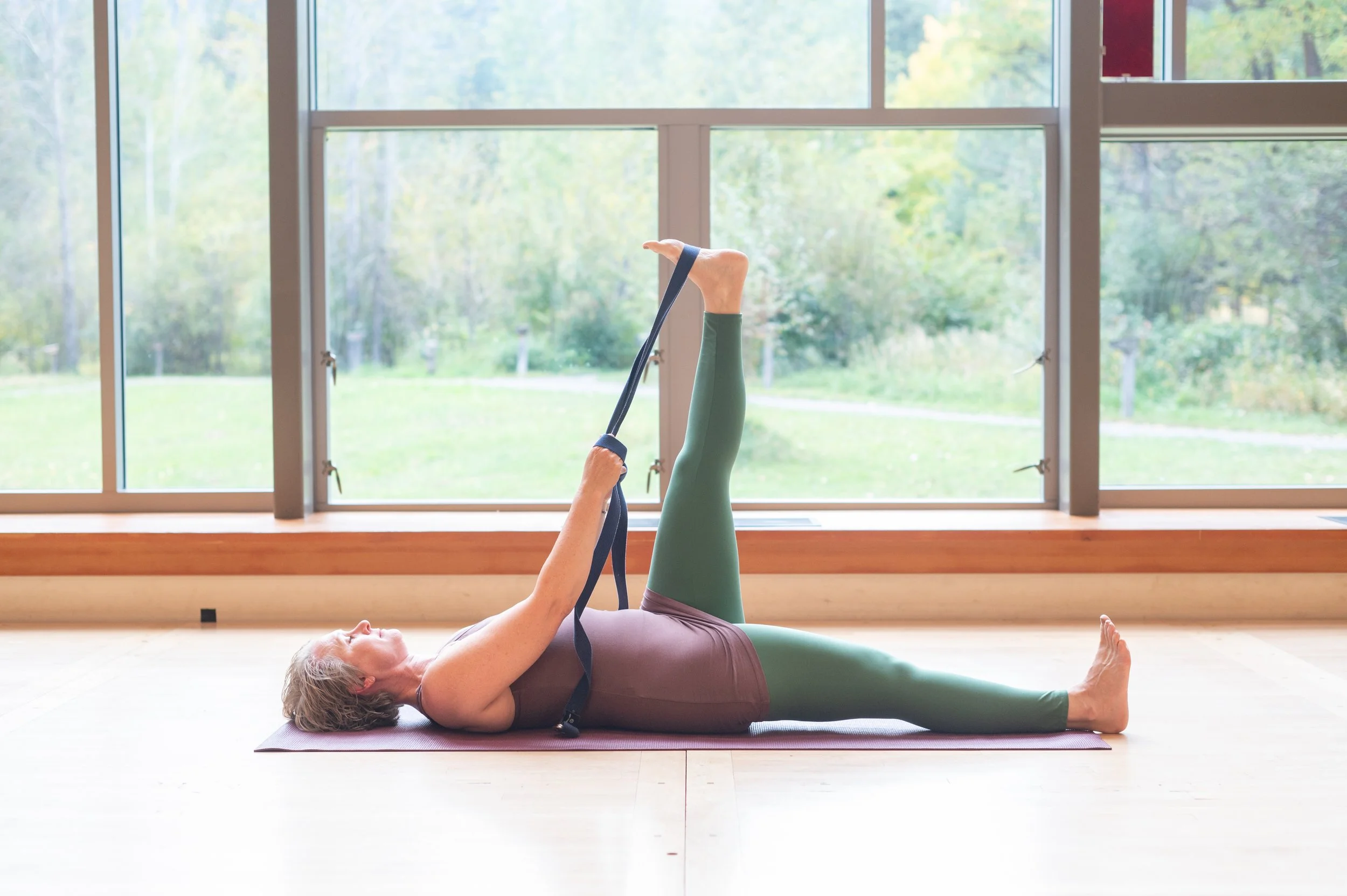
This pose is Supta Pandangusthasana in sanskrit, meaning “supine hand to big toe pose”… However, if your toe seems quite far away from your hand, you can use a strap as an “arm extender” to make it more accessible.
Why the hamstrings deserve your attention
The hamstrings run along the back of the thigh, connecting the sitting bones to the lower leg. They play a role in almost every movement we make from walking, standing, bending, and stabilizing the pelvis.
When they become tight or underused, other parts of the body often try to compensate. You may notice tension in the lower back. You may feel restricted when bending forward. Or you may simply feel stiffness when getting up from sitting.
Regular hamstring exercises at home can help restore balance. Not by forcing flexibility, but by gently inviting length and circulation back into the muscles.
Over time, this can support greater ease not just in yoga, but in everyday life.
A supported hamstring stretch you can practice anywhere
This is one of the simplest and most effective hamstring stretches, and it’s the version we often practice in class.
Supta Pandangusthasana (Supine Hand to Big Toe Pose) - supported lying hamstring stretch
Lie down on your back with both legs extended.
Bend one knee toward your chest.
Loop a band, towel, or strap around the ball of your foot.
Slowly extend your leg upward, only as far as feels manageable.
Keep a slight bend in the knee if needed.
Allow your shoulders, neck, and jaw to soften.
Stay for 5–10 slow breaths.
Release and repeat on the other side.
Modification option: For those who are “hamstring challenged” and find it difficult to straighten the leg or find their leg trembling during the stretch, try elevating the pelvis with a blanket or bolster. This should make the position more accessible.
The strap allows your arms to remain relaxed and your shoulders to stay on the floor. This creates the conditions for the hamstrings to release more naturally.
This is one of the most useful hamstring exercises at home because it removes the effort of holding the leg up or the struggle of trying to reach your foot with your hand. You can focus instead on breathing and noticing.
Less effort, more awareness
It can be tempting to think the goal is to make the leg completely straight. But that isn’t necessary.
What matters more is your ability to breathe comfortably.
If the stretch feels aggressive, the nervous system responds by tightening to protect you. When the stretch feels manageable, the body is more willing to let go.
Often, softening your jaw, relaxing your shoulders, and slowing your breath has more impact than trying to push the leg further.
This is where hamstring exercises become something more than physical. They become a way of practicing attention.
A standing hamstring stretch adapted from yoga class
You may also recognize this movement from class. It’s simple and accessible.
standing forward fold with bent knees
Stand with your feet hip-width apart.
Bend your knees generously.
Fold forward, allowing your torso to rest on your thighs.
Let your head and arms hang.
Slowly begin to straighten your legs only to the point where your breath stays easy.
Stay for several breaths.
Keeping the knees bent protects the lower back and allows the stretch to be focused where it’s intended.
This is one of the most practical hamstring exercises at home because it integrates easily into your day.
Especially helpful when traveling or sitting more than usual
Hamstring exercises at home can be particularly supportive if you’ve been traveling, sitting for long periods, or spending more time at a desk.
Sitting shortens the hamstrings over time. Gentle stretching helps restore length and circulation.
Even a few minutes can make a noticeable difference.
You may find that your walking feels easier. Your lower back feels less burdened. Your whole posture feels more supported.
The role of the nervous system in muscle release
One of the most important things to understand is that muscles release when the nervous system feels safe.
This is why breathing, pacing, and support matter so much.
A hamstring stretch done with force often creates resistance. The same stretch done with patience often creates release.
This is also where meditation can be a powerful complement to physical practice. Joanna’s online meditation series offers simple practices that help calm the nervous system, which directly supports the body’s ability to release tension.
Many students notice that combining meditation with gentle movement changes not just how their body feels, but how they relate to their body.
A small, consistent practice goes a long way
You don’t need a long routine.
One or two hamstring exercises, practiced regularly, is enough.
Lie down.
Use a strap, band or towel.
Lift one leg.
Breathe.
Let that be enough.
Over time, the hamstrings begin to respond. The body begins to trust the process. And movement begins to feel easier again.
These small moments of attention accumulate. Quietly, steadily, and in ways that support you well beyond the stretch itself.
I’m an experienced yoga retreat leader located in Leavenworth, WA. I run retreats in the Pacific Northwest and beyond as well as day-retreats in the Leavenworth area.